
5B20.20 • Gauss's Law: Faraday's Cage with Wimshurst
Location: Cabinet 1
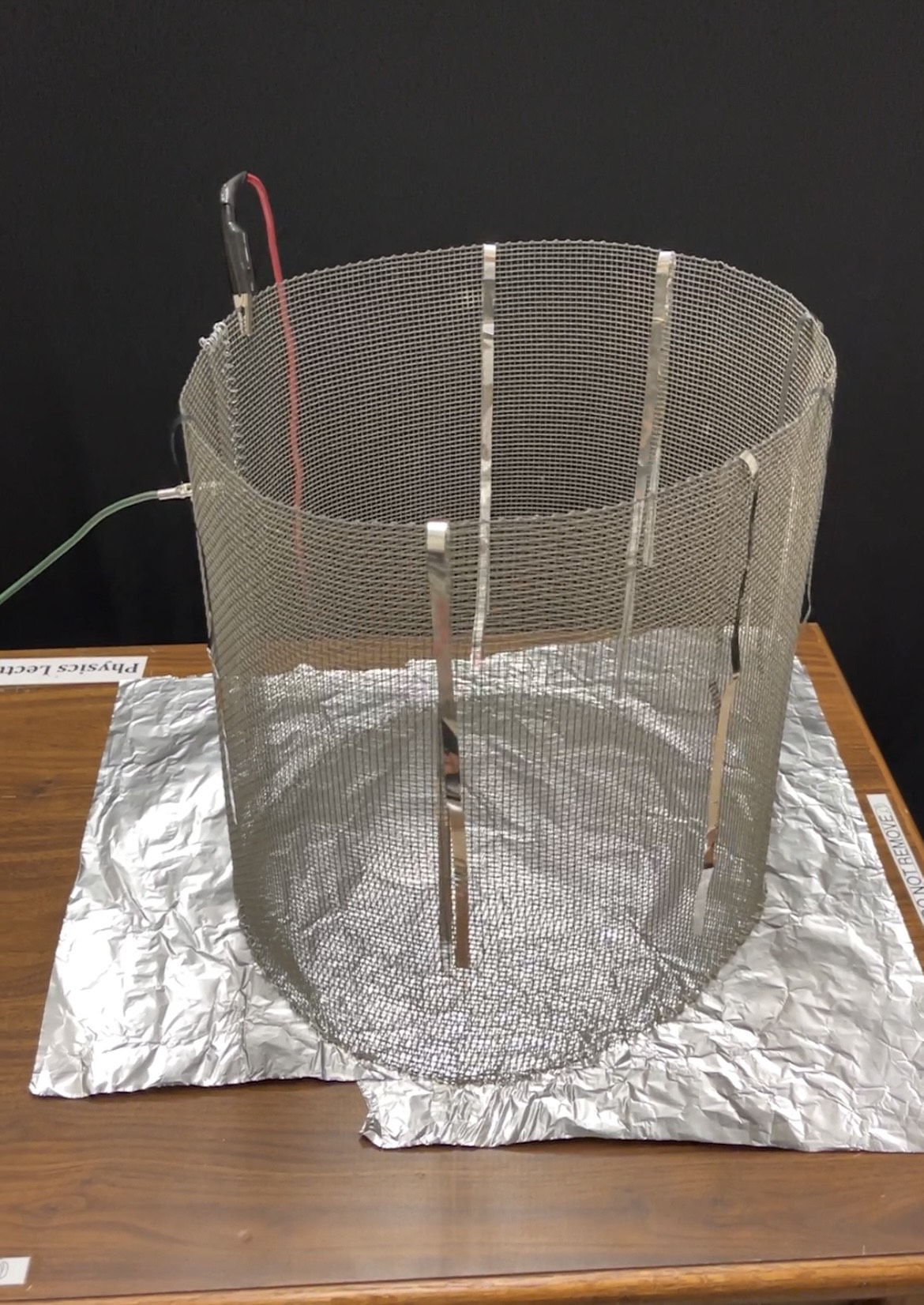
Photo shoes the demonstration used at the University of Texas at Austin.
Concepts Conveyed:
- Faraday's cage is made up of conductive metal mesh. When external electric charges are provided, electrons inside the cage will move to reach electrostatic equilibrium. With Gauss’s Law, the net electric flux and internal electric field inside the cage is 0.
- When electric charges are provided to Faraday's cage by the Whimshurst machine, electrons will only move on the outside surface of the cage toward the grounding wire to produce an electrostatic shielding effect.
- Tinsels outside of the Faraday's cage will be temporarily negative and repel each other while tinsels inside the Faraday’s cage will stay neutral to confirm the 0 electric field inside the Faraday’s cage.
Instructions/Notes:
- Place a tinfoil underneath the Faraday’s Cage, ensure it covers all areas.
- Put about 6 tinsel foils on the Cage and space them up evenly.
- Attach the grounding wire on top of the Faraday’s Cage near the overlapping area.
- Connect the Whimshurst machine with the Faraday’s Cage using the conducting wire near the middle of the Faraday’s Cage.
- Separate the two electrodes of the Whimshurst machine far apart so that they will not discharge each other.
- Remove everything else from the table and inside the cage before cranking the Whimshurst machine.
- Turn the crank on the Whimshurst machine clockwise until tinsel foils on the Faraday’s Cage began to repel each other and fly up.
- Discharge the demonstration with a discharging rod. Please do not touch the Whimshurst machine or Faraday's cage right after the demonstration with your hands.
Demo Staff:
- Discharge everything before setting up the demo and putting it back.
- Ensure a discharging rod is provided with the demo.
Last updated on June 22, 2026